


Childhood Squint: Understanding When a Child’s Eyes Don’t Look Straight

Parents often notice it in small moments.A photograph where one eye seems to wander.A glance when the child is tired, daydreaming, or looking into bright sunlight. Sometimes a relative points it out casually: “One eye looks a little off, but they’ll outgrow it.”
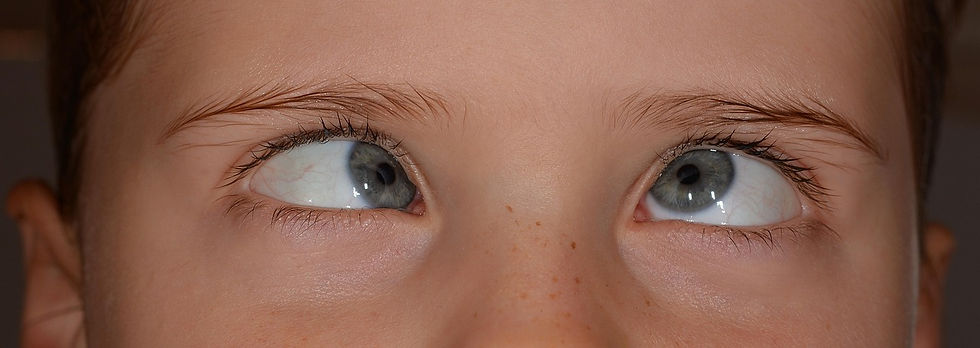
This is how childhood squint, or strabismus, usually enters a family’s awareness quietly, uncertainly, and often surrounded by reassurance that everything will be fine.
Sometimes it is.Often, it is not.
Childhood squint is one of the most common eye conditions seen in children, and also one of the most misunderstood. It is frequently dismissed as cosmetic, temporary, or insignificant. In reality, it can have a lasting effect on how a child sees the world quite literally.
This article is written for parents, caregivers, and anyone who works closely with children. You do not need medical knowledge to understand it. You only need curiosity, attention and willingness to look a little closer.
What Do We Mean by Squint?
In simple terms, a squint means that both eyes are not pointing in the same direction at the same time.
When the eyes are properly aligned, they move together and focus on the same object. The brain receives two similar images and blends them into one clear picture, giving us depth perception and a sense of space.

In a squint, one eye may turn inwards towards the nose, outwards towards the ear, or occasionally upwards or downwards. The deviation may be constant, or it may come and go. Some children squint only when they are tired or unwell. Others have a noticeable deviation all the time.
A useful question to ask yourself is this: when your child looks at you, do both eyes appear to be looking at you together? If the answer is not always, the observation deserves attention.
Is Squint Ever Normal in Babies?
This is one of the most common and most confusing questions parents ask.
In the first few weeks of life, a baby’s eye movements are not fully coordinated. Brief, occasional wandering of the eyes can be seen, especially when the baby is sleepy. This usually settles as eye control develops.
However, there is an important distinction between occasional and constant misalignment. A squint that is present most of the time, or one that persists beyond the first three to four months of life, is not considered normal. A constant squint at any age, even in a newborn, should be evaluated.
If you are unsure whether what you are seeing is real or just an illusion, you are not expected to decide on your own. That is precisely why eye examinations exist.
When It Looks Like a Squint, But Isn’t
Some babies appear to have crossed eyes when they do not. This is often due to a flat nasal bridge or prominent skin folds at the inner corners of the eyes. These facial features can give the impression that the eyes are turning inwards, especially in photographs.
This is called a pseudo-squint.
The important thing to know is that a pseudo-squint is harmless and does not affect vision. The equally important thing is that it should be diagnosed by an eye professional, not assumed.
True squint and pseudo-squint can look remarkably similar to an untrained eye.
Why Squint Is Not Just About Appearance
It is easy to assume that a squint is mainly a cosmetic issue. After all, the eyes still seem to function, and the child appears to manage daily activities well enough. But this assumption misses something crucial: how the brain responds to misaligned eyes.
Imagine trying to watch two television screens at once, each showing a slightly different programme. The brain finds this confusing. In a young child, rather than tolerate confusion or double vision, the brain does something remarkable and potentially harmful. It begins to ignore the image coming from one eye. This is not a conscious choice. It is a protective mechanism. Over time, the brain learns to rely on the straighter eye and suppress the other. When this happens, the ignored eye does not develop normal vision. This condition is known as amblyopia, or lazy eye.
Lazy eye is not a problem of the eye itself. The eye may be structurally normal. The problem lies in how the brain has learned, or failed to learn, to use it. And once a certain window of childhood development closes, this learning becomes extremely difficult to reverse.
The Window of Vision Development
A child’s visual system is not fully formed at birth. Vision develops rapidly in the first few years of life, as the brain learns to interpret the images it receives from the eyes.
This period of development is time-sensitive. If one eye is not used properly during these years, the brain does not 'catch up' later in life. This is why untreated squint in childhood can result in permanent reduction of vision in one eye, even if the eye itself is healthy.
Parents often ask whether treatment can wait until the child is older and more cooperative.
The uncomfortable truth is that waiting may make treatment less effective.
How Squint Can Affect a Child Beyond Vision
Vision is only part of the story. Children with misaligned eyes may struggle with depth perception. Tasks that require judging distance like catching a ball, pouring water, climbing steps can become harder. Some children adapt well; others become hesitant or clumsy.
There is also the social aspect. Children are acutely aware of differences, both in themselves and in others. Studies have shown that visible eye misalignment can affect peer interactions and self-confidence, even at a young age. This is not about vanity. It is about helping a child see well, function comfortably, and feel confident in social settings.
What Causes Childhood Squint?
There is rarely a single cause. In many children, uncorrected farsightedness plays a role. When a child has to focus hard to see clearly, the eyes may turn inwards as part of that effort. Correcting the refractive error with glasses can, in some cases, straighten the eyes.
In other children, there may be a family history of squint, or issues related to prematurity or neurological development. Sometimes squint develops because one eye has poorer vision due to another condition, such as a cataract or a drooping eyelid. When one eye does not see well, it may drift because the brain does not prioritise its alignment.
This is why a proper evaluation looks beyond the eye position alone.
How Is Squint Diagnosed in Children?
Many parents worry that their child is too young to be tested properly. In reality, eye doctors are trained to assess eye alignment and vision even in infants and toddlers. They use age-appropriate methods, games, lights, and observations that do not require the child to read letters or follow complex instructions.
A thorough assessment includes checking how the eyes move, how well each eye sees, whether glasses are needed, and whether the eyes themselves are healthy. This is not something that can be reliably done through photographs or online screening tools alone.
Treatment: What Can Actually Be Done?
Treatment for childhood squint is not one-size-fits-all. It depends on the type of squint, the child’s age, the presence of lazy eye, and the underlying cause.
In some children, simply wearing the correct glasses straightens the eyes and allows normal visual development to continue. In others, additional treatment is needed to strengthen the weaker eye. This may involve patching the stronger eye for a prescribed period each day, or using eye drops to temporarily blur it.
When eye alignment does not improve sufficiently with these measures, surgery on the eye muscles may be recommended. This often sounds alarming to parents, but squint surgery is a well-established procedure. It adjusts the balance of the muscles that move the eyes, allowing them to align more effectively.
It is important to understand that surgery is not a failure of earlier treatment. It is simply one part of a broader plan to restore alignment and support vision.
A Common Question: Is Surgery Only Cosmetic?
This belief persists, and it needs correcting.
While surgery does improve the appearance of the eyes, its purpose goes beyond cosmetics. Proper alignment helps the brain use both eyes together. In children, this can support the development of binocular vision and depth perception. Even in older children and adults, alignment improves comfort, confidence, and social interaction.
Calling squint surgery “cosmetic” undervalues its functional and psychological benefits.
What Happens If Squint Is Left Untreated?
Not every squint leads to severe problems, but the risk is real.
Untreated squint in childhood can result in permanent lazy eye, poor depth perception, and limitations in certain careers later in life. It can also leave a child adapting unnecessarily to a problem that could have been addressed earlier.
Perhaps the most difficult aspect is that, once the opportunity for visual development has passed, it cannot be reclaimed.
Signs That Should Prompt an Eye Check
If a child has a constant eye turn, a noticeable squint beyond infancy, a head tilt, or frequently closes one eye in bright light, these are not habits to ignore. Neither is the concern of a parent who feels something is not quite right.
You do not need to wait for school age. You do not need to wait for complaints. Vision problems in young children are often silent.
A Final Word to Parents
If you have noticed a squint in your child, you have already done the most important thing: you have noticed. Seeking an eye examination is not overreacting. It is not being anxious. It is being attentive. Childhood squint is common, treatable, and, when addressed early, often life-changing in quiet but profound ways. Vision is something a child carries into every classroom, every playground, and every future choice.
Looking after it early is one of the simplest and most powerful gifts you can give.


Comments