


Discover the 7 Muscles That Control Your Eye Movements

Imagine being locked in a single frame, unable to pan across a breathtaking landscape or follow a child's laughter across the playground?

Our eyes, thankfully, are far from static. They dance, dart, and pirouette with every thought, every curiosity, every fleeting moment. Do you know what orchestrates this mesmerizing ballet??
The answer lies in a team of seven heroes: Our extraocular muscles.
Think of them as the puppeteers behind the curtain, pulling and twisting the eye with invisible strings.
Understanding these muscles is not just an anatomical feat; it's a doorway to appreciating the intricate symphony of our vision.
So, join me on a journey into the world of eye movement. We'll know each muscle, their actions, and discover how they collaborate in seamless harmony.
Meet the Eye Muscles:
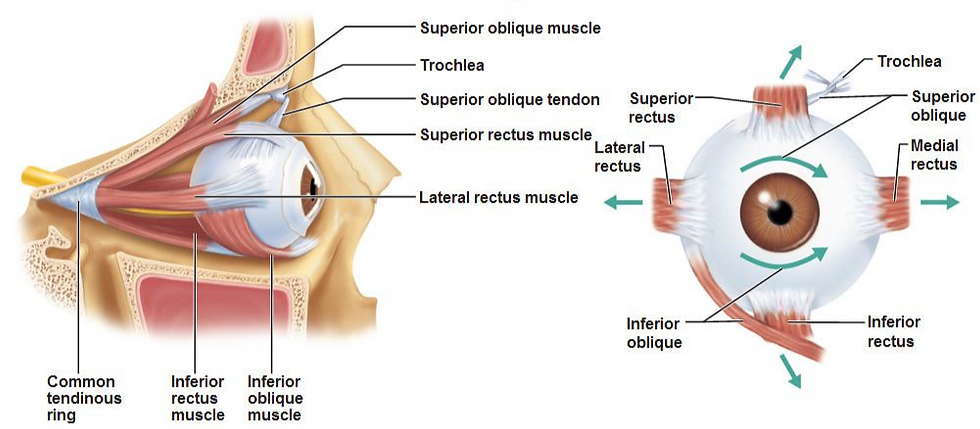
Superior rectus: This muscle sits on top of the eyeball and is responsible for lifting the eye when we look up. Imagine it like a tiny puppeteer pulling the eye upwards with a string.
Inferior rectus: Located on the bottom of the eyeball, this muscle works in opposition to the superior rectus, lowering the eye when we look down. Think of it as a counterweight, balancing the eye's position.
Medial rectus: Situated on the inner side of the eyeball, this muscle pulls the eye nasally, bringing objects closer to our noses.
Lateral rectus: On the outer side of the eyeball, this muscle is the star of eye movements towards the temple.
Superior oblique: This muscle runs diagonally from the back of the eye socket to the front, and its action is a bit more complex. It rotates the eye inwards and downwards, helping us tilt our heads and maintain a level gaze.
Inferior oblique: Located opposite the superior oblique, this muscle rotates the eye outwards and upwards, working in synergy to maintain a balanced view. Think of it as the superior oblique's partner in the eye-tilting movement.
Levator palpebrae superioris: This muscle isn't directly attached to the eyeball, but it plays a crucial role in eye movement. It's responsible for lifting the upper eyelid, allowing us to open our eyes .
Beyond the Basics: A Peek into Eye Movements:
But the story doesn't end there! These seven muscles collaborate in intricate ways to produce various types of eye movements, allowing us to explore our visual world with precision and efficiency. Here's a sneak peek into some key terms we'll delve into in a future blog:

Adduction and abduction: Imagine your eyes like windows. Adduction moves both windows inwards, focusing on a close object near your nose. Abduction does the opposite, opening the windows wider to take in a broader view.
Intorsion and extorsion: These terms refer to twisting movements of the eyeball. Intorsion turns the top of the eye inwards, like looking at the tip of your nose. Extorsion does the opposite, tilting the top of the eye outwards.
Supraduction and infraduction: These movements involve both lifting and tilting the eye. Supraduction lifts the eye and tilts it slightly inwards, like looking up at the stars. Infraduction lowers the eye and tilts it slightly outwards, like looking down at your toes.
Understanding these extraordinary muscles equips us not just with knowledge, but with appreciation. We marvel at the effortless agility of our eyes, the seamless coordination that allows us to observe the world with a glance. We see not just with our eyes, but with the invisible orchestra playing behind them.
It's the symphony that paints the canvas of your world, one blink, one glance, one breathtaking view at a time.
Do let us know about our blog in the comments below.


Comments