


Exploring the Depths of Emotion: The Role of Eyes in Hindi Literature

Updated: Feb 2, 2023
Eyes are often said to be the windows to the soul, and in literature, they serve as powerful symbols that can convey the innermost thoughts and feelings of a character.

Hindi literature, in particular, has a rich tradition of using the imagery of eyes to paint a vivid picture of a character's emotions.
This blog will delve into the symbolism of eyes in Hindi literature, exploring the ways in which different authors have used this powerful imagery to convey the complex inner worlds of their characters. The eyes are often said to be the window to the soul, and in Hindi literature they serve as powerful symbols that convey the emotions of a character. From the earliest examples to contemporary works, we will take a chronological journey through the years, examining the ways in which Hindi literature has used eyes to reveal the depths of human emotion.
1. Tulsidas Ramayan

In 'Shri Ramcharitmanas' (Devanagari: श्रीरामचरितमानस Rāmacaritamānasa) by Goswami Tulsidas (1574), is a Hindu epic written by the poet-saint Tulsidas in the 16th century. It is a retelling of the story of Lord Rama, an incarnation of Lord Vishnu, as described in the Hindu epic Ramayana. The poem presents a moral and devotional tale of Lord Rama's life, his battles against evil forces, his love for his wife Sita, and his ultimate triumph over the demon king Ravana. It is considered one of the greatest works of Indian literature and is widely revered by Hindus as a spiritual guide. The poem highlights the importance of devotion, morality, and righteousness in leading a virtuous life.
The eyes of Lord Rama are described as being filled with compassion and love for all creatures. They serve as a symbol of Rama's divine nature and ultimate goodness. The eyes are used as a representation of Rama's innermost thoughts and emotions, and they help to convey the message of love and compassion that is central to the Ramayana.
2. Chandrakanta
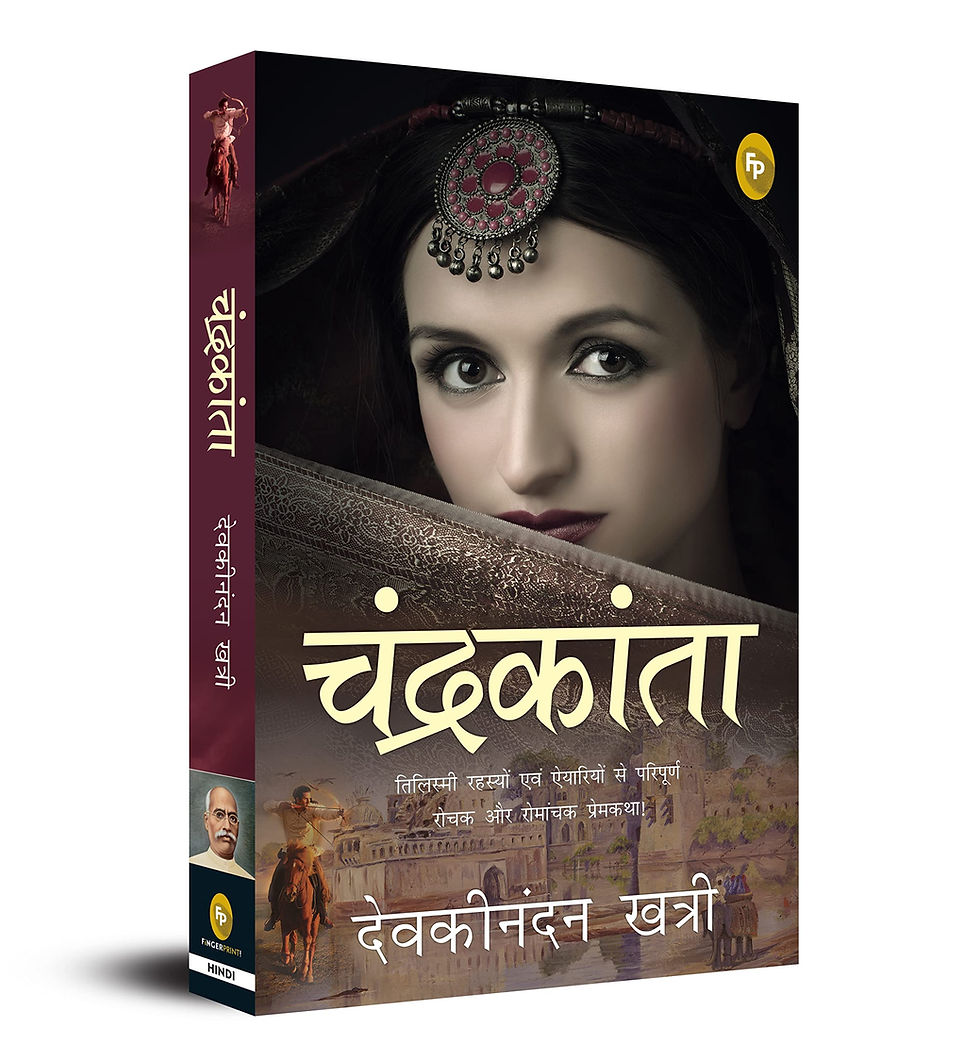
'Chandrakanta' (Devanagri-चन्द्रकान्ता ; IAST-Candrakāntā) by Devaki Nandan Khatri (1888) is an epic fantasy novel. The story revolves around the kingdom of Vijaygarh and its beautiful princess, Chandrakanta. The prince of the neighboring kingdom, Irawan, falls in love with Chandrakanta and they plan to get married. However, a series of obstacles and enemies stand in their way, including the evil sorcerer, Marich. With the help of magic and bravery, Chandrakanta and Irawan overcome these challenges and finally get married, uniting the two kingdoms. The novel is a thrilling journey filled with adventure, love, and magic.
The eyes of the female protagonist Chandrakanta are described as being like stars, shining with beauty and intelligence. They serve as a symbol of her strong and independent nature. The eyes convey the character's intelligence, beauty and her determination. They also convey to the reader, her independent nature and her desire to break free from the societal norms.
3. Bade Ghar Ki Beti

Let us talk about, "Premchand ki kahaniya" by Munshi Premchand (1914). It is a story of a wealthy landlord who has two daughters and the challenges they face in a patriarchal society. The elder daughter, who is the protagonist, is married into a lower-class family, and the novel explores her struggles to find her place in a new household and the society. The novel highlights themes of social justice, gender discrimination, and the moral decay of the traditional Indian society. It is considered a classic of Indian literature and is still widely read and studied today.
The protagonist is a young girl who reflects on the harsh realities of life. Her eyes are described as being filled with tears and sorrowful due to the difficult situations she faces daily.
The eyes convey the deep emotions of sadness, duress and suffering that she endures. They serve as a window to her soul and help readers to understand and connect with her struggles and pain.
4. Chitra

'Chitra' by Rabindranath Tagore (1917), is a short story. It is a tale of two princes who are lost in a forest and come across a palace owned by a beautiful princess named Chitra. The princess challenges the two princes to a game of archery in which they must shoot a fruit from a tree while blindfolded. The prince who succeeds in hitting the fruit wins Chitra's hand in marriage. The elder prince, who is arrogant and confident, fails to hit the target while the younger prince, who is humble and kind, succeeds and wins Chitra's heart. The story is a lesson about the virtues of humility and the dangers of pride and arrogance. The protagonist is the young prince who is torn between his duty to his kingdom and his love for a woman in the palace.
The eyes of the prince are described as being filled with longing and a sense of inner turmoil. They serve as a symbol of his struggle between his duty and his desire. The eyes convey the character's internal conflict, his longing for the woman and his duty.
5. Nirmala

Nirmala is a novel written by Munshi Premchand (1924). It is a story about a young girl named Nirmala who is married off at a young age to a man much older than her. The novel explores the themes of love, sacrifice, and the oppression of women in rural India. Nirmala must navigate the complexities of her arranged marriage and find a way to assert her independence while also honouring her traditional duties.
Despite facing numerous obstacles, she remains strong and determined, and her resilience serves as a powerful message to young women everywhere.
The eyes of the protagonist are described as being filled with innocence and a longing for freedom. They serve as a symbol of her youth and her desire for self-expression and confidence. The eyes convey the young character's longing for breaking from her traditional shackles.
6. Holi

Holi, also known as the festival of colors, is a popular Hindu festival celebrated in India and other parts of South Asia. Holi celebrates the victory of good over evil and the arrival of spring. People gather and throw coloured powder and water at each other, sing and dance, and feast on sweets and delicacies. The poem "Holi" by Subhadra Kumari Chauhan (1930) captures the essence of this joyful celebration and its cultural significance. The poem conveys the celebratory mood and the celebrants' excitement as they play with colors, sing and dance, and forget their worries. The poem highlights the essence of Holi as a festival of unity, love, and renewal.In ‘Holi’, the protagonist is a common man who expresses the joy and excitement of the festival of Holi.
The speaker talks about the sparkling eyes of children playing with colors, and the twinkling eyes of lovers meeting secretly. The eyes are used as a symbol of the joy and happiness that is associated with the festival of Holi. They help to convey the message of the poem which is about the celebration of the festival and the happiness it brings.
7. Kafan

‘Kafan' is a short story written by Indian author Munshi Premchand. It revolves around the life of a poor village man named Dhania who tries to arrange a proper shroud for his deceased, very pregnant wife.
Despite his financial struggles and constant rejections from the wealthy, Dhania does not give up hope and eventually finds a way to give his wife a dignified funeral. The story highlights the plight of poverty and the importance of human dignity and compassion.
The eyes convey the deep emotions of despair, hopelessness, and the acceptance of death and poverty. They serve as a window to his soul and help readers to understand and connect with his final thoughts in life.
His character has been known for his introspection and deliberation about all things that money can buy and those which it cannot.
8. Godan

Godan by Premchand (1936) is a classic Hindi novel set in rural India during the early 20th century. The story revolves around the life of Hari, a poor farmer who struggles to make ends meet for his family. He dreams of owning a cow but fate has other plans for him.
The novel showcases the harsh realities of rural life, where poverty and caste discrimination are prevalent, and the struggles of a poor farmer to find a better life. Through Hari's journey, the novel highlights the importance of education, hard work, and perseverance in overcoming adversity. Godan is a poignant tale of hope and resilience in the face of adversity and is considered one of Premchand's best works.
The protagonist is a poor farmer who struggles with poverty and social injustice. The eyes of Hari are described as being filled with determination and a longing for a better life. They serve as a symbol of his resilience and his desire to overcome the obstacles that stand in his way. The eyes convey the character's determination, his strength and his hope for a better future. The story was brought to the silverscreen by late Mr Balraj Sahni and late Mrs Nirupa Roy in the tragic ‘Do beegha zameen’.
9. Rangbhoomi

'Rangbhoomi' is a novel written by Premchand (1938), the famous Hindi author.
t is a social commentary that sheds light on the issues of poverty and inequality in rural India.
The novel follows the story of a young man named Kallu who is determined to bring change to his village, but is faced with opposition from the wealthy and powerful landowners.
Through Kallu's struggles, the novel explores themes of social justice, the power of education, and the need for solidarity and cooperation among the oppressed.
Despite its serious subject matter, 'Rangbhoomi' is a hopeful and inspiring tale that shows the power of one person to make a difference in the world.
10. Sampatti

Sampatti by Yashpal (1938) is a novel that explores the theme of wealth and its impact on society. The protagonist of the story, who has a large fortune, struggles with the consequences of his wealth, including greed and corruption, as well as the loss of relationships with those closest to him.
Through his journey, the reader is shown the harsh realities of what happens when wealth is pursued at any cost. The novel ultimately reveals the true value of family, friendship, and the importance of living a simple and honest life.
The protagonist is a wealthy businessman who is blind in one eye. The eyes of the protagonist are described as being filled with a sense of emptiness and a longing for something more.
They serve as a symbol of his spiritual poverty and his search for meaning in his life. The eyes convey the character's spiritual emptiness and his search for something deeper in life.
11. Dharm ke Saathi
In 'Dharma ke saathi' by Bhagwati Charan Verma (1944), the protagonist is a wife who comes to terms with the betrayal by her husband. The protagonist's eyes are described as being filled with tears as she comes to terms with the fact that her husband has betrayed her. The eyes convey the deep emotions of betrayal, loss and hurt. They serve as a window to her soul and help readers to understand and connect with her.
12. Ansu Sambhal Lega

Ansu Sambhal Lega is a Hindi novel by Rajendra Yadav (1956) that explores the lives of ordinary people living in a small town in India. It literally means, checking one’s tears. The story revolves around the protagonist, Ram Khilawan, and his family who face various challenges in their daily lives such as poverty, discrimination, and social pressure. The novel highlights the importance of standing up for oneself and the power of unity in the face of adversity. Through its humour and heartwarming moments, Ansu Sambhal Lega teaches readers about the resilience and perseverance of the human spirit.
In 'Ansu Sambhal Lega', the protagonist is a young man who is struggling to cope with the loss of his family. The eyes of the protagonist are described as being filled with sadness and a sense of hopelessness. They serve as a symbol of his grief and his search for meaning in the face of tragedy. The eyes convey the character's grief and hopelessness.
13. Mai Baap

'Mai Baap' is a novel written by Phanishwar Nath Renu (1955) and is set in rural Bihar, India. The story is about a father who is looked upon as the epitome of authority and power in his village, but his children question his traditional beliefs and values, leading to a struggle between old traditions and modern ideologies. The novel explores themes of patriarchy, power dynamics, and changing cultural values in rural India.
'Mai Baap’ is a story which revolves around the story of a poor father and his struggles to provide for his family. The protagonist's eyes are described as sad, weary, and full of pain, reflecting the struggles and hardships he endures in his daily life.
Other notable contributions in Hindi literature are from the following authors:
14. Rangbhoomi:
Written by Chhaganlal Pandya, this novel explores the themes of love and sacrifice through the story of two young lovers. The protagonist's eyes are described as soft and full of tenderness, reflecting the depth of his love for his beloved.
15. Saara Akash
Written by Rajendra Yadav, this novel tells the story of a young man's journey to discover the truth about his life and identity. The protagonist's eyes are described as questioning and curious, reflecting his desire for self-discovery and the pursuit of truth.
16. Basant
Writen by Jaishankar Prasad, this novel explores the themes of love and sacrifice through the story of two young lovers. The protagonist's eyes are described as bright and full of life, reflecting his love for his beloved and his longing for their union.
17. Khamoshi Ke Taare
Writen by Kaka Hathrasi, This novel is a satirical work that pokes fun at the customs and traditions of Indian society. The protagonist's eyes are described as full of mischief and humor, reflecting the lighthearted tone of the novel.
18. Madhushala
Written by Harivansh Rai Bachchan, the eyes are used as a symbol of the longing for a lover. The speaker pours his heart out, describing how he yearns to see his beloved's eyes again.
19. Kavita
In "Kavita" by Sarveshwar Dayal Saxena (1925), the eyes are used to convey the longing for the divine. The speaker speaks of how his eyes long to see the face of God. The eyes are used as a symbol of the longing and desire for the divine. They help to convey the message of the poem, which is about the longing for spiritual enlightenment.
20. Saudagar
In "Saudagar" by Mahasweta Devi (1989), the protagonist is a tribal woman who faces the injustices and oppression faced by marginalised communities. The eyes of the protagonist are described as being filled with pain and suffering. They serve as a powerful reminder of the injustices and oppression faced by marginalized communities. The eyes are used as a symbol of the protagonist's struggle and the harsh realities of life that she must endure. The eyes convey the deep emotions of suffering and injustice, and they help to convey the message of the novel.
In conclusion, the use of eyes as a symbol in Hindi literature has been a recurrent theme throughout history, with different authors utilizing it in different ways to convey the emotions and innermost thoughts of their characters.
From the earliest examples of Hindi literature to contemporary works, the symbolism of eyes has been used to provide a deeper understanding of the characters and their emotions. The eyes are often said to be a reflection of one's soul, and in Hindi literature, they serve as a powerful tool for authors to reveal the complexities of human emotions.
This blog has only scratched the surface of the rich tradition of using the imagery of eyes in Hindi literature, and we hope it has inspired readers to explore further and discover the many ways in which this powerful symbol has been used over the years. Whether it is to convey longing, love, sorrow or any other emotions, the eyes have been used as a powerful tool to express the innermost thoughts of the characters.


Well written